A timely dialogue between Ulrike Gravert-Jenny and Admir Šahmanović, Montenegro’s Minister of Energy and Mining, on CBAM, security of supply, and the looming risk of an energy-system collapse.
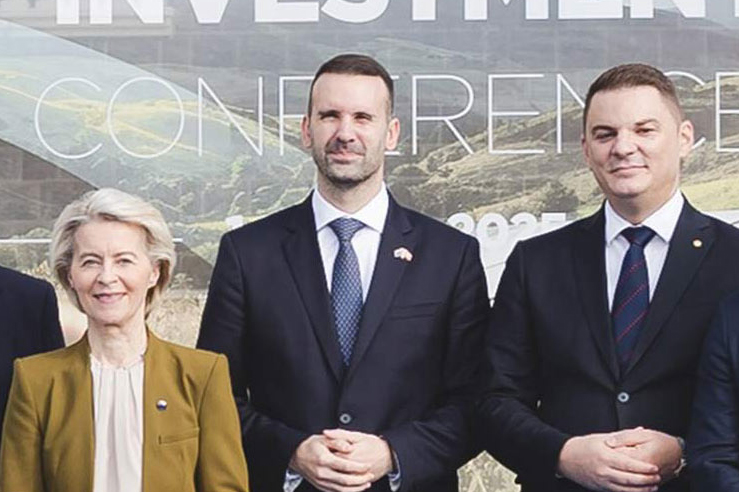
Six weeks ago, the major investment conference in Luštica Bay took place. Many international companies attended — even European Commission President Ursula von der Leyen. How did you experience the event?
Minister Šahmanović: It was a powerful signal. President von der Leyen stated very clearly: “Investing in Montenegro means investing in the European Union.” We are in the final stretch toward EU accession — we expect to become a member in two years — and that visibly reassured investors.
We held numerous discussions with companies interested in renewable energy. At the same time, we are fully harmonizing our national energy legislation with EU law. By December, everything will be adopted, Chapter 15 will be closed, and Montenegro will be fully aligned with the EU regulatory framework.
We also signed the market-coupling agreement with Italy. In 18 months, we will be fully integrated into the European electricity market. Together with TERNA, we have even agreed to build a second submarine cable to Italy, which will double our export capacity.
“Investing in Montenegro means investing in the European Union…
…So far, we have already attracted around €500 million in new energy investments. Montenegro has the potential to become an energy bridge between the EU and the Western Balkans.”
The EU’s Carbon Border Adjustment Mechanism (CBAM) becomes binding on 1 January 2026. How do you see it? Will CBAM support or jeopardize the development of your renewable export model?
Minister Šahmanović: CBAM is — as they say in Germany — a game spoiler. It destroys our plans.
We are not ready for CBAM — and this applies not only to us but to the entire region. We have tried to explain this to the European Commission and the Energy Community Secretariat, but we are not being granted any transition period.
“We need at least three years to prepare CBAM properly. The EU itself needs 18 months to integrate us into the internal market — why are we not granted the same 18 months to prepare for CBAM?”
How dramatic would the economic consequences be?
Minister Šahmanović: Quite concerning. In 2024, we exported more than 3 TWh of electricity to the EU — part of it transit power, mainly from Greece. Yet CBAM is expected to apply to transit flows as well. That makes no sense.
For importers, CBAM will add €65.42 per megawatt hour. This makes our exports uncompetitive and our prices unsustainable.
We traditionally export in the first and fourth quarters — this stabilizes our system, keeps household prices low, and secures liquidity for our state-owned utility.
If we lose access to the market, we risk: • the collapse of our national energy company, • massive losses for our transmission system operator, and • destabilization of regional power flows, since Greece can export only through our infrastructure.
I will not give up. We have written to the European Commission again — CBAM in its current form is simply not survivable for us.
CBAM is intended to promote climate protection, yet you argue it threatens your decarbonization path. What does this mean for international investors who depend on legal certainty and predictable cashflows?
Minister Šahmanović: Exactly. CBAM is counterproductive to the energy transition. We have 65 renewable projects in the pipeline — almost all solar — as well as plans for an LNG terminal and potentially a gas-fired power plant.
But investors are already asking: “What is your post-CBAM business model? Is it stable? Which cashflows are secure?”
“Even small investment projects are now under scrutiny. If CBAM is applied without adjustments, it could destroy the investment climate we have worked so hard to build.”
Let’s talk about your thermal power plant, which produces around 40 percent of your country’s electricity. What is happening there?
Minister Šahmanović: We have a serious problem. The plant provides baseload — in summer, up to 75 percent. Without this capacity, our system collapses. Solar and wind cannot provide baseload. For that, we need a new hydropower plant or a gas plant.
What happens on 1 January 2026 if there is no solution? Does a fragile system facing a 2026 cliff edge?
Minister Šahmanović: We will suffer.
Our state-owned energy company will come under enormous pressure. Our national ETS — which will later transition into the EU ETS — would cost an additional €75–80 million annually. For a country of our size, that is enormous.
We urgently need a transition period. Otherwise, our system may collapse before we can even build the renewable capacity we are planning.
Your final thoughts on CBAM?
Minister Šahmanović: I will continue travelling to Brussels. I will keep fighting.
We are ready to invest, to reform, and to operate under EU rules. But we need breathing space. CBAM must not destroy us before we even have the chance to become climate-neutral.
“Let me put it the way I feel regarding CBAM: we are at the table, ready to go all-in — but we need fair cards. You might accuse us of having waited too long, but since I took office, we have made every effort to tackle this issue constructively.”
About Admir Šahmanović
Minister of Energy and Mining, Montenegro
Admir Šahmanović (born 1985) holds a Master’s degree in Financial Management. He has extensive experience in sustainable development, the European Green Deal, renewable energy, energy efficiency, ESG implementation, strategic planning, and EU funds management. He has worked on green investment projects, public administration reform, and financial analysis of energy projects in both the public and private sectors.
Professional experience: • 2010–2013: Senior Associate, Audit & Consulting, PwC (Montenegro & Serbia) • 2013–2016: Ministry of Sustainable Development and Tourism – EU Funds Management • 2016–2017: Project Coordinator, British Council, Podgorica • 2017–2022: Director General, Directorate for International Cooperation and Assistance Programs, Ministry of Public Administration • 2022–2024: State Secretary, Ministry of Capital Investments • 2024–present: Minister of Energy and Mining, Montenegro
He has been actively involved in Montenegro’s EU accession process, leading negotiation chapters on transport, energy, environment, climate action, and public administration reform. He is fluent in English, Dutch, and German, married, and the father of two children.